Insurance claims execution
Claims intake, demonstrated once, replayed exactly — and checked against the claims database.
See OpenAdapt run the full loop on a real open-source insurance system: a health-facility claim is entered once in openIMIS, compiled into a governed local program, and replayed with a fresh claim number — with success established only by a direct SQL read of the claim row, never by pixels or self-report.
Use supported APIs for adjudication, coverage, and core claims logic. OpenAdapt completes the repeated last-mile intake or update trapped in a portal or claims UI, then verifies the result against the claims database.
Real application footage
See the workflow in openIMIS, then compare the same loop across industries
The clips show the captured source demonstration and a real compiled replay. The evidence panel links to the exact application version, media hashes, trials, and database verification boundary.
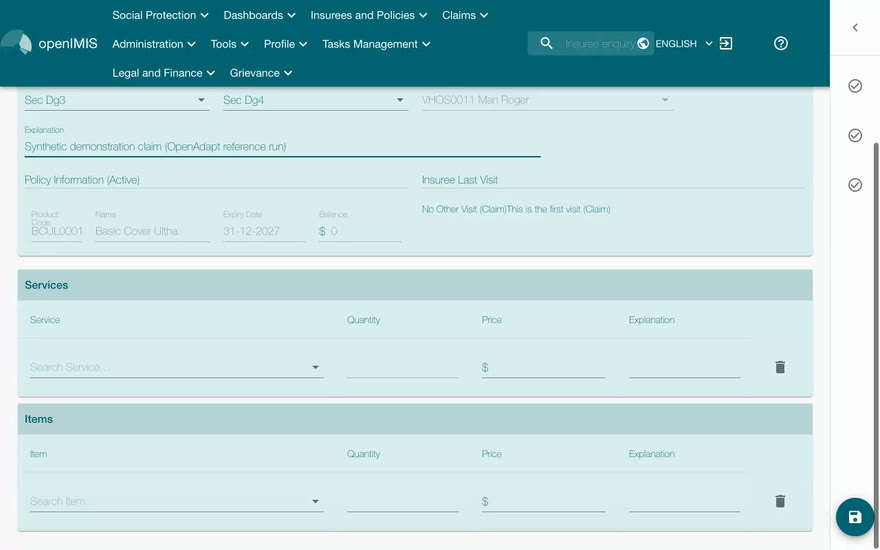
Source-derived evidence sequence from the openIMIS compiled replay; not literal continuous footage.
- 1DemonstrateCapture the task and its evidence.
- 2ExecuteReplay the compiled workflow locally.
- 3Verify or haltProve the effect, or stop for review.
Why the oracle matters here
The costly failure in claims operations is not a crash — it is the claim that is silently entered twice, or against the wrong policyholder, and surfaces weeks later in reconciliation. Every run in this reference is accepted only when the claims database shows exactly one new claim row, in status Entered, for the demonstrated policyholder and facility. A duplicate or missing row fails the run loudly instead of reporting success.
Where the execution layer fits
- First notice of loss or claims intake re-keyed from an existing structured source into a portal or claims UI with no supported API.
- A bounded status-update or document-attachment step at the edge of an otherwise API-driven claims pipeline.
- Hand QC and compliance an illustrated report of every run: what ran, what it saw, what changed.
Put one claims workflow into production
Bring one repeated intake or update step and the claim record that proves its outcome. We'll map the deployment, verification, shadow run, and supervised rollout.
Qualify one workflow